

Someone else must have run this experiment before...
They almost certainly have. The problem is that what they learned is published as guidance, while the setup itself stays trapped in their lab. Weekly Papers #4 on why scientific structure rarely travels.
TL;DR: For many common experiments, science already knows what should be recorded, checked and reported. The problem is that this knowledge mostly lives in papers and guidelines, while experiments happen somewhere else. Every lab is left to translate the standard into its own setup by hand. Fifteen years of reporting guidelines suggest that this translation does not happen reliably. Maybe the missing piece is not another guideline, but a way to share and install the structure itself.
There is a strange class of problem in science: one where the answer is known, widely agreed upon, and still rarely followed.
Take quantitative PCR. In 2009, a group of researchers published the MIQE guidelines: 85 things that should be reported when describing a qPCR experiment, 57 of them considered essential [1]. Animal research has ARRIVE [2]. Biomedical resources have standards for uniquely identifying antibodies, cell lines and other materials [3].
These guidelines exist because the same problems kept appearing. Important details were omitted. Materials could not be identified. Experiments were difficult to interpret or reproduce. So people with experience in the field sat down and wrote out what a good experiment should contain.
In principle, that should have helped.
Fifteen years later, the results are not encouraging.
A recent review of 439 qPCR papers in leading journals found that sample quality was reported in only 7–10% of studies, assay efficiency in 5–8%, and reference-gene stability in 0.4%. Only two of the 439 papers cited MIQE [4].
ARRIVE followed a similar path. Ten years after its introduction, randomisation was reported in roughly 30–40% of animal studies, while fewer than 10% justified their sample size. Its own authors concluded that the improvement they had expected had largely not happened [2].
And in a study of research resources, 54% could not be uniquely identified from the paper. That result did not meaningfully change with the field, the prestige of the journal, or whether the journal had reporting requirements [3].
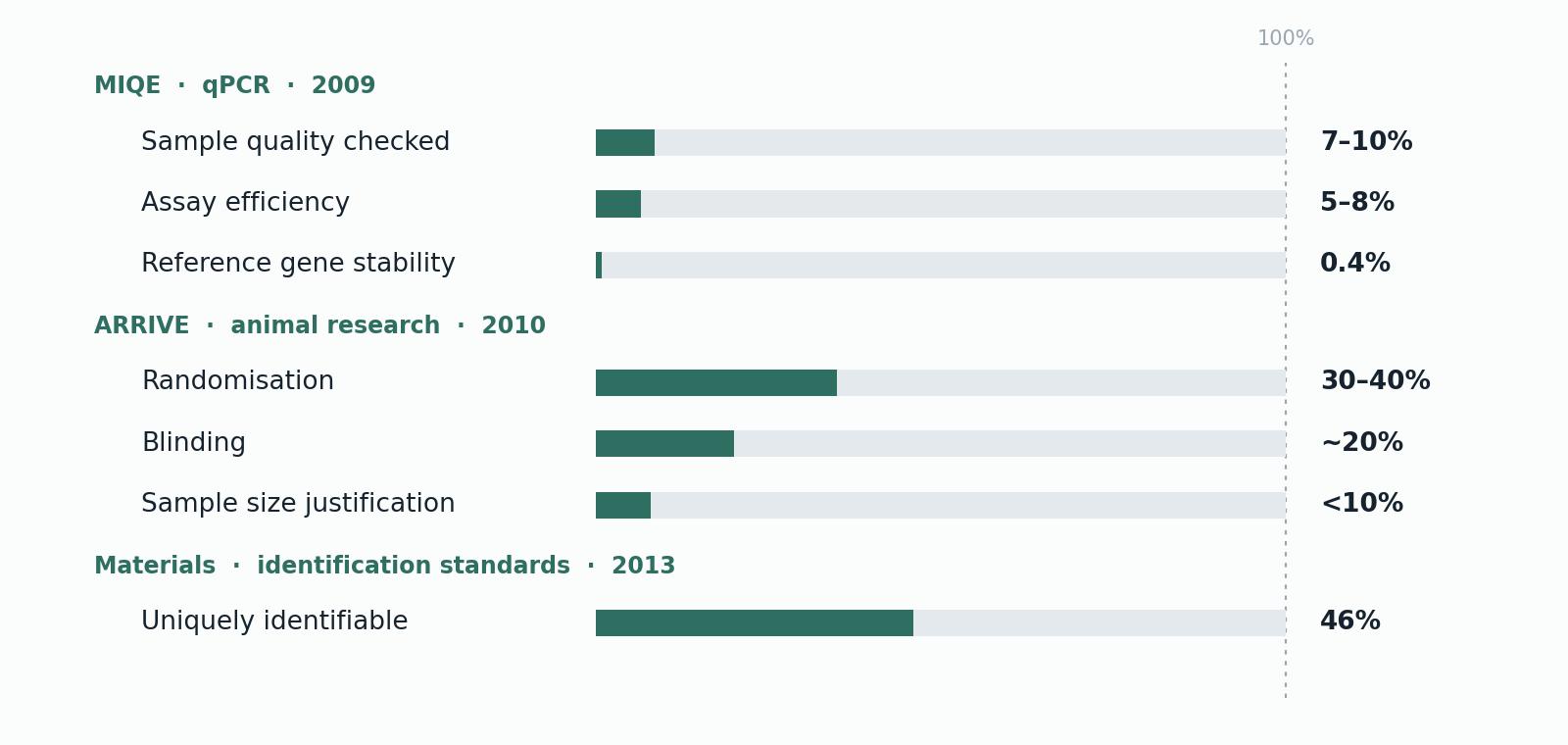
Sources: [4] for MIQE, [2] for ARRIVE and [3] for resource identification.
So why does something that is broadly agreed to be good practice fail to become normal practice?
The usual answers are incentives, time pressure, careless authors and reviewers who do not enforce the rules. Those all matter. But there is a more mundane problem underneath them.
The guideline and the experiment live in different places.
A guideline is a document. You can read it, cite it and download it.
Then you go back to the software where the experiment actually happens, and most of that structure disappears.
Someone has to recreate it.
They need to decide which fields to add, which checks to make, how to name things, where calculations should happen and what should make its way into the final report. If they change software, move institutions or train a new colleague, some of that work happens again.
We have made the standard shareable, but not the setup that implements it.
That distinction matters.
ARRIVE provides a useful example. Asking authors to submit a completed checklist did not measurably improve reporting. Better results appeared when the checklist became part of the editorial process and people followed up on missing information [2].
The difference is small but important. In one case, the structure existed somewhere else and the author was expected to remember to apply it. In the other, the process itself began to enforce the structure.
Most research software still looks much more like the first case.
This also means that good implementations are difficult to spread.
Imagine a lab that has spent years refining a particular assay. Their workspace contains the right metadata, controls, calculations, naming conventions and quality checks. New researchers inherit a setup in which good practice is already the easiest path.
That setup may be extremely useful to another lab doing the same work.
Today, there is usually no obvious way to give it to them.
You can publish a paper describing the experiment. You can publish a protocol. You can upload the data. You can write a checklist explaining what someone else should record.
But the working structure itself tends to remain buried inside one lab's ELN, spreadsheets, scripts and institutional conventions.
There is no common unit for sharing it.
That becomes especially visible when someone tries to reproduce published work. The Reproducibility Project: Cancer Biology examined 193 experiments from 53 influential papers. None contained enough information to design a replication without contacting the original authors [5].
That does not mean the missing information never existed. Some of it almost certainly did. It may have been sitting in notebooks, spreadsheets, software fields, emails or people's heads. It simply did not survive the journey into the paper.
The costs of that gap are difficult to measure precisely, but the estimates are large. Chalmers and Glasziou argued that avoidable weaknesses consume a substantial share of biomedical research investment [6]. Freedman and colleagues estimated the cost of irreproducible preclinical research in the United States at roughly $28 billion per year [7].
We tend to describe this as a reproducibility problem or a reporting problem. But those labels start at the end of the process.
The earlier question is: where was the structure supposed to come from in the first place?
This is where we think scientific software has something to learn from software itself.
In software development, useful structure is routinely packaged. Someone solves a problem once, makes the solution reusable, and other people install it rather than reconstructing it from a paper describing how it works.
Parts of science already work this way. nf-core, for example, lets researchers build on community-maintained bioinformatics pipelines rather than assembling the same analysis infrastructure from scratch in every lab [8].
There is no obvious reason the idea should stop at analysis.
A qPCR setup could be a package. So could a microscopy workflow, a behavioural assay or a sample-processing pipeline.
Instead of MIQE existing only as a list of things you ought to remember, it could exist as a working setup: the relevant fields already present, the expected controls visible, the calculations connected to the inputs they depend on, and the report generated from the same structure.
A lab could install it, adapt it, version it and publish its improvements.
That does not mean every part of a research workflow should be public.
Companies and laboratories have good reasons to keep hypotheses, data, experimental details and accumulated know-how private. But much of the scaffolding around that work is not where the advantage lies.
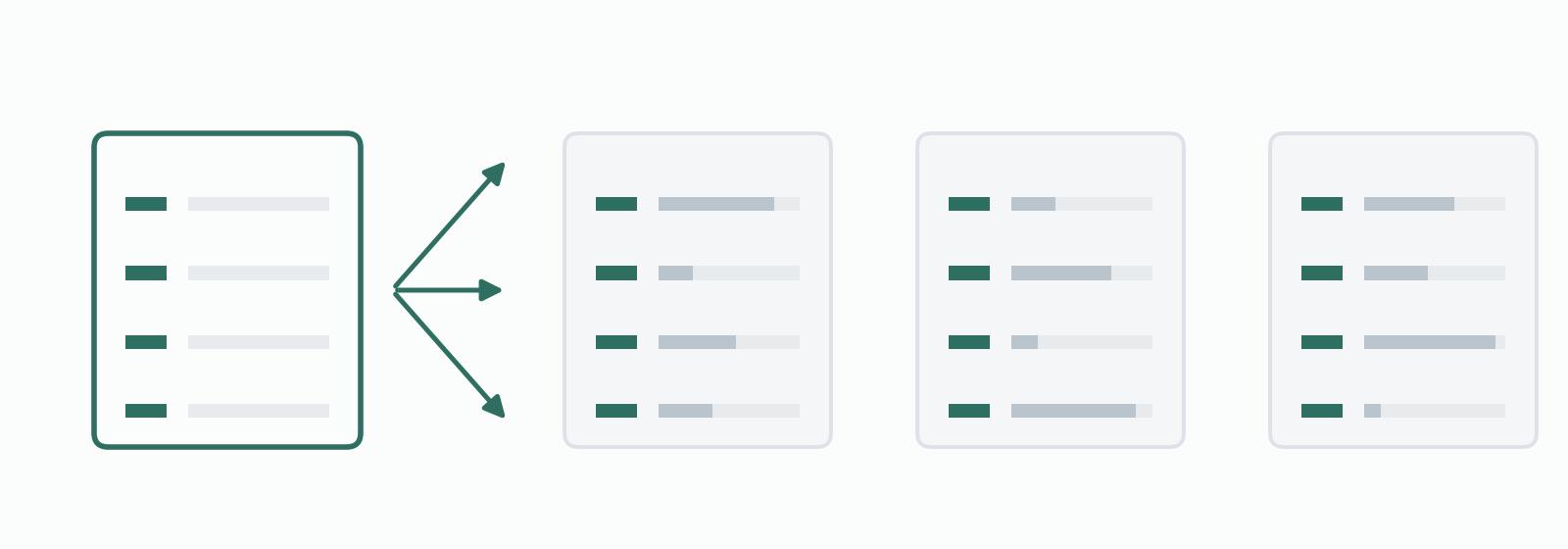
Fields for sample provenance are not a competitive advantage. Neither is a well-designed control table. Neither is remembering which metadata a method requires.
Yet thousands of organisations independently rebuild versions of these things because there is no easy way to inherit them from someone who already did the work.
That is the idea behind Dalea, and it connects to the argument we made in Weekly Paper #1: scientific work has useful structure beyond the final document [9].
We think more of that structure should be able to travel.
Reporting guidelines have given us a useful fifteen-year experiment. Publishing the answer is not enough. Asking people to remember the answer is not enough. In some cases, even requiring the answer is not enough.
So perhaps the next question is not what another guideline should say.
It is what would happen if you could install one.
If you joined a new lab tomorrow, what would you want to inherit on day one?
And of the structure your own lab has built, what would you actually lose by sharing it?
References
-
Bustin SA, Benes V, Garson JA, et al. The MIQE guidelines: minimum information for publication of quantitative real-time PCR experiments. Clinical Chemistry, 2009;55(4):611–22. doi.org/10.1373/clinchem.2008.112797
-
Percie du Sert N, Hurst V, Ahluwalia A, et al. The ARRIVE guidelines 2.0: updated guidelines for reporting animal research. PLOS Biology, 2020;18(7):e3000410. doi.org/10.1371/journal.pbio.3000410
-
Vasilevsky NA, Brush MH, Paddock H, et al. On the reproducibility of science: unique identification of research resources in the biomedical literature. PeerJ, 2013;1:e148. doi.org/10.7717/peerj.148
-
Drude N, Baselly C, Gazda MA, et al. Reporting quality of quantitative polymerase chain reaction (qPCR) methods in scientific publications. Research Integrity and Peer Review, 2026;11:6. doi.org/10.1186/s41073-026-00188-0
-
Errington TM, Denis A, Perfito N, Iorns E, Nosek BA. Challenges for assessing replicability in preclinical cancer biology. eLife, 2021;10:e67995. doi.org/10.7554/eLife.67995
-
Chalmers I, Glasziou P. Avoidable waste in the production and reporting of research evidence. The Lancet, 2009;374(9683):86–9. doi.org/10.1016/S0140-6736(09)60329-9
-
Freedman LP, Cockburn IM, Simcoe TS. The economics of reproducibility in preclinical research. PLOS Biology, 2015;13(6):e1002165. doi.org/10.1371/journal.pbio.1002165
-
Ewels PA, Peltzer A, Fillinger S, et al. The nf-core framework for community-curated bioinformatics pipelines. Nature Biotechnology, 2020;38:276–8. doi.org/10.1038/s41587-020-0439-x
-
Dalea. An ELN isn't just an ELN. Weekly Papers #1, July 2026. dalea.market/posts/an-eln-isn-t-just-an-eln