

An ELN isn't just an ELN
When we share lab work, we argue about export formats — PDF, CSV, a folder of attachments. But that's the wrong question. Before asking how to export the work, ask what the work actually is: a protocol, a data model, code, queries, and charts that depend on one another. Weekly Papers #1 on why the natural unit of scientific sharing is the package, not the page.
TL;DR — Scientific work is more than a document. Dalea packages the protocol, data model, code, queries, charts, and the relationships between them — so another researcher can recreate the working process with a single import instead of rebuilding it by hand.
** What are we actually sharing?**
When we talk about sharing an electronic lab notebook, we usually talk about export formats: a PDF, a CSV, maybe a folder of attachments. But that starts from the wrong question. Before asking how to export the work, we should ask what the work actually consists of.
An experiment is not just its written protocol. It is often a data model defining what gets recorded, code that processes the measurements, queries that select and aggregate the data, and charts that present the result. These parts depend on one another: the chart uses the query, the query uses the data model, and the document ties everything into a process a researcher can follow. Together they form a working system — and the notebook page is only one view of it [1].
** The shareability gap**
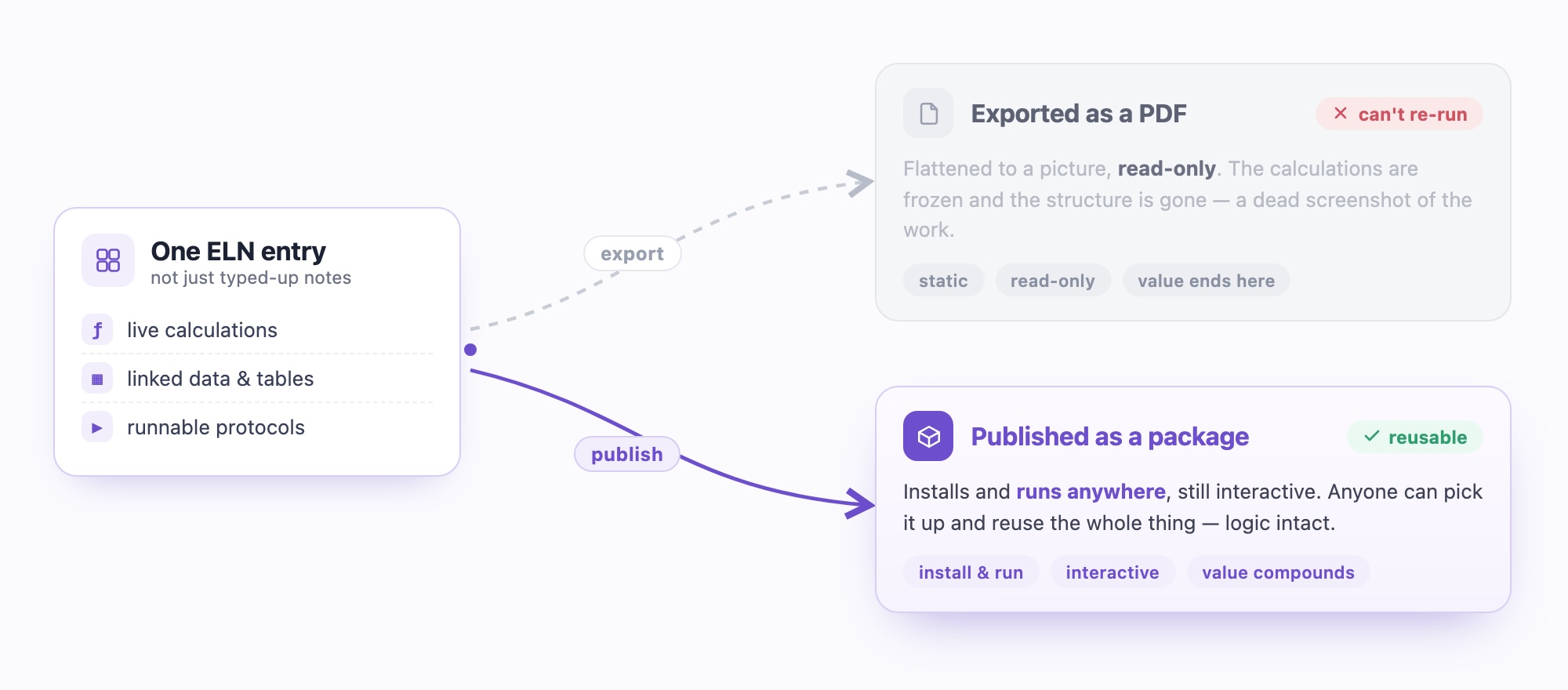
Inside an ELN, that system stays structured and interactive. When it leaves the workspace, it is usually flattened into a document.
The recipient can read the protocol and inspect the final chart, but the machinery underneath is gone. The chart no longer knows which query produced it. The calculation is a number, not something that can run again [2]. The data model has to be rebuilt by hand. Code and dependencies may not travel at all. The information has been shared; its functionality has not.
So a better test of shareability is not whether someone can open the export — it is whether they can continue working from it. Can they recreate the data environment? Run the same analysis? Do the charts reconnect to their sources? Could they repeat the experiment without rebuilding its entire digital infrastructure by hand? When most researchers already struggle to reproduce each other's work — and their own [3] — handing over a flattened file only makes a hard problem harder.
** From documents to packages**
This is why we think the natural unit of scientific sharing is the package, not the page. Reuse and validation do not come from raw files; they come from first-class objects that carry their methods, structure, and relationships with them [4].
A package can hold any combination of the objects that make up a scientific process:
-
- Documents and protocols
-
- Templates and structured blocks
-
- Data models and relationships
-
- Data and results
-
- Saved queries and calculations
-
- Charts and dashboards
-
- Analysis code and executable tools
-
- Files, provenance, and version history
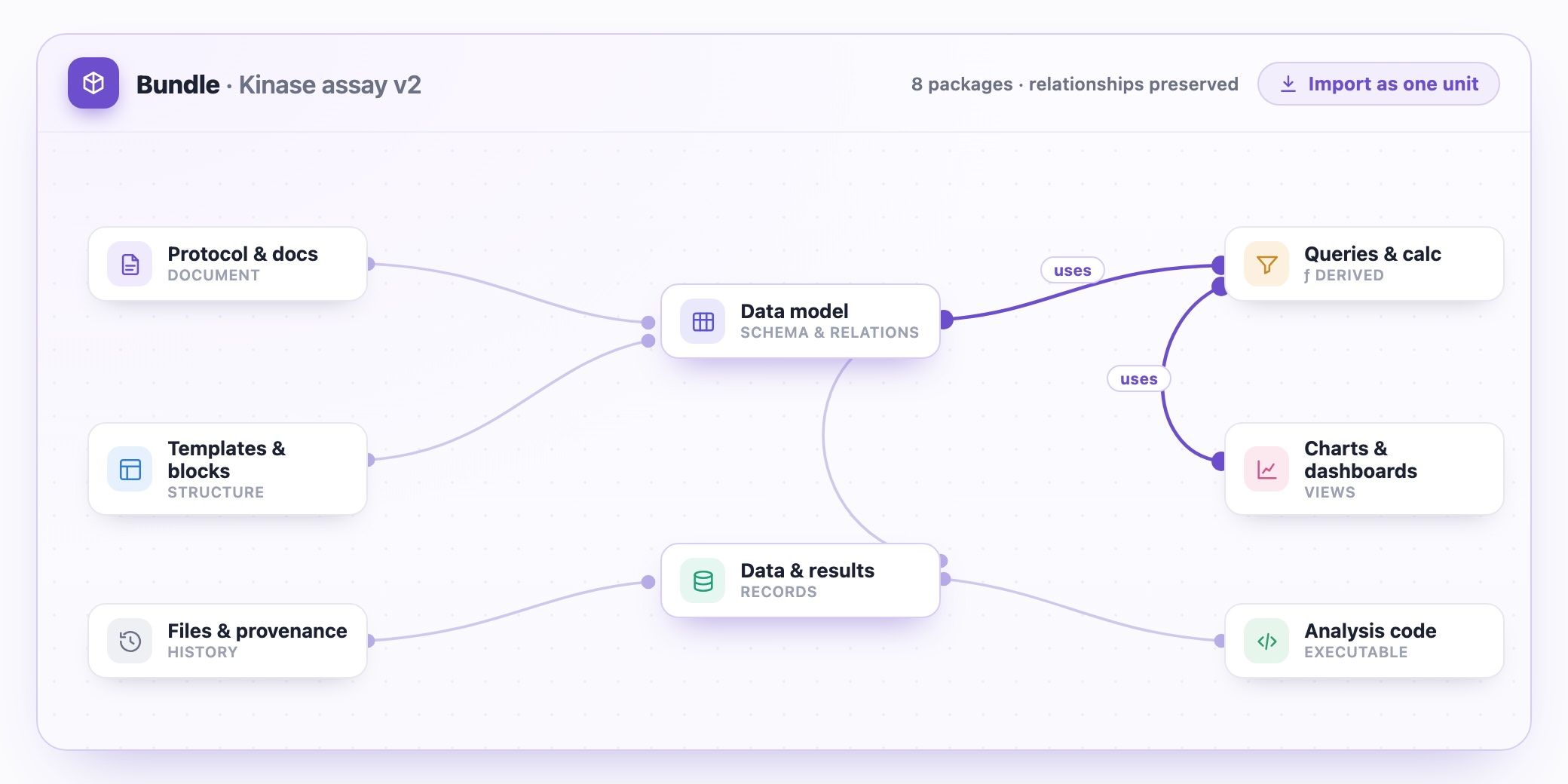
Crucially, it preserves both the individual components and the relationships between them — the way a self-describing research package bundles its parts with machine-readable metadata so it can be picked up whole [5]. A package can represent a reusable method, a complete analysis, or an end-to-end workflow. If it includes the original data, another researcher can reproduce the analysis. If it includes only the structure and method — the templates and schema — they can apply the same process to their own data [6].
** What this means in Dalea**
Dalea treats everything in the platform as a reusable building block. A Dalea package might contain an assay protocol, its sample and result schemas, the analysis code, a saved query that calculates normalized response, and the chart that displays the outcome.
When another researcher imports that package, Dalea recreates each component as a native object and reconnects the relationships between them. The chart still knows its query. The query still knows its data model. The document still points to the right tables, code, and results. From the recipient's side, it is one import click — they are not handed instructions for rebuilding the workflow; they receive the workflow itself.
** Export preserves the look. A package preserves the work.**
That is the difference between exporting and publishing. An export preserves what the work looked like; a package preserves how the work works.
PDFs still matter as readable, durable records — they simply should not be the entire handoff. Scientific work is connected, structured, and increasingly executable; if we want it to be genuinely open, FAIR-aligned, and reusable, we have to share it at that level [7].
An ELN does not just store pages. It stores working knowledge. Package that knowledge, and someone else can reproduce it, adapt it, and build on it.
** References**
-
Dirnagl U, Przesdzing I. A pocket guide to electronic laboratory notebooks in the academic life sciences. F1000Research, 2016. doi.org/10.12688/f1000research.7628.1
-
Ince DC, Hatton L, Graham-Cumming J. The case for open computer programs. Nature, 2012. doi.org/10.1038/nature10836
-
Baker M. 1,500 scientists lift the lid on reproducibility. Nature, 2016. doi.org/10.1038/533452a
-
Bechhofer S, Buchan I, De Roure D, et al. Why linked data is not enough for scientists. Future Generation Computer Systems, 2013. doi.org/10.1016/j.future.2011.08.004
-
Soiland-Reyes S, Sefton P, Crosas M, et al. Packaging research artefacts with RO-Crate. Data Science, 2022. doi.org/10.3233/ds-210053
-
Musen MA, O'Connor MJ, Schultes E, et al. Modeling community standards for metadata as templates makes data FAIR. Scientific Data, 2022. doi.org/10.1038/s41597-022-01815-3
-
Wilkinson MD, Dumontier M, Aalbersberg IJ, et al. The FAIR Guiding Principles for scientific data management and stewardship. Scientific Data, 2016. doi.org/10.1038/sdata.2016.18